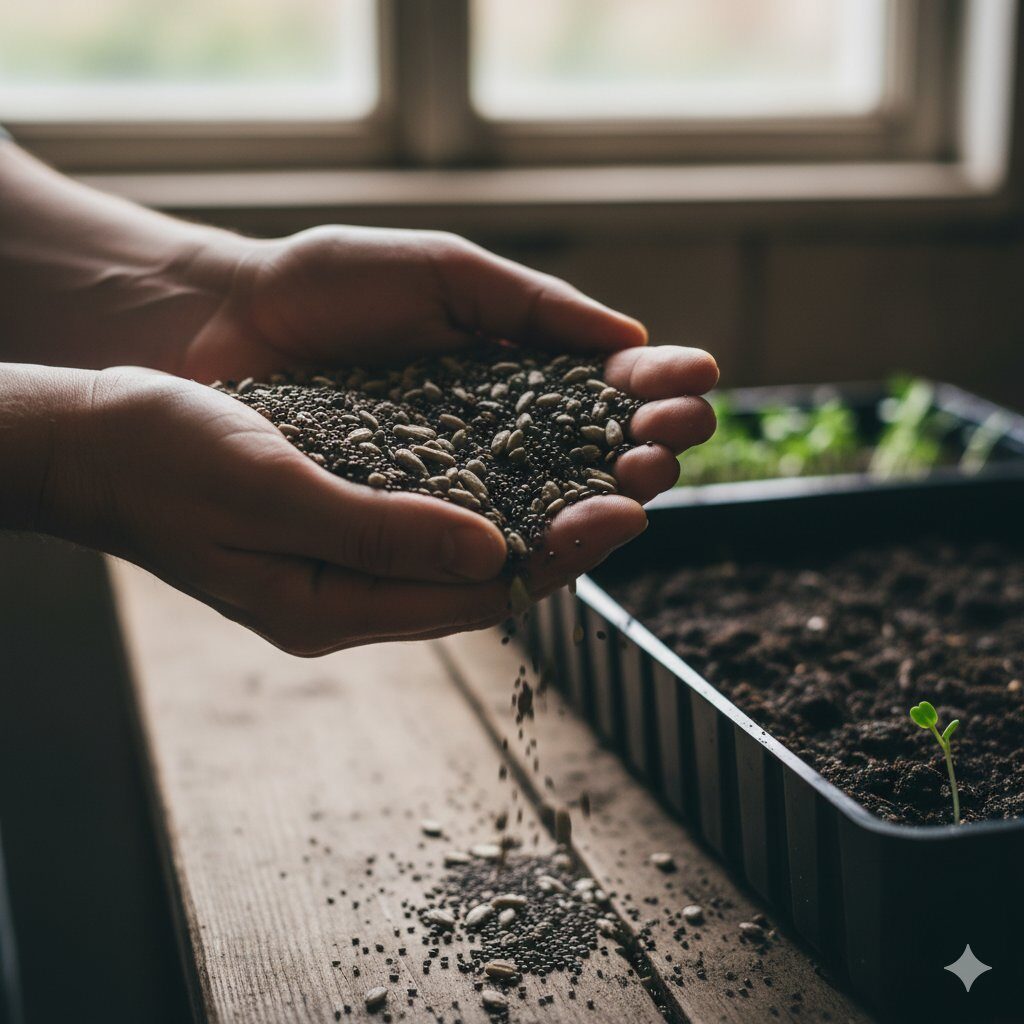
There is a lot of noise around microgreens. Some of it is legitimate science. Some of it is marketing dressed as science. The two are genuinely hard to tell apart if you don't know what to look for — specifically, whether a study was done in a petri dish, in a mouse, or in an actual human being.
That distinction matters enormously, and most microgreens content on the internet ignores it entirely. This page doesn't. Every health claim below is tagged with its evidence level so you can judge the strength of the research for yourself.
Why does the cotyledon stage matter so much?
Microgreens contain 4 to 40 times the concentration of certain vitamins and carotenoids compared to the same plants at maturity. Human study This is not a marketing claim. It comes from a 2012 study by Xiao, Lester, Luo and Wang at the University of Maryland and USDA's Agricultural Research Service, which analysed 25 commercially grown microgreen varieties and compared their nutrient content against the USDA National Nutrient Database for mature vegetables.
The researchers themselves were surprised. "We were really surprised," said Dr. Qin Wang. "Some of the numbers were really, really high. We thought it might have been a mistake but we double-checked so many times and there were no mistakes." Red cabbage microgreens showed 6 times more Vitamin C than mature red cabbage and 69 times more Vitamin K. Cilantro microgreens had the highest total carotenoid concentrations of all 25 varieties tested.
The Singh et al. 2024 review in Food Chemistry: X confirms this pattern holds specifically at the cotyledon stage and notes that "the short growth cycle of microgreens prevents any significant reduction in the concentration of bioactive compounds." This is the scientific basis for everything that follows.
What does the research show for specific health conditions?
The finding: Fenugreek (methi) microgreen extract inhibited the enzyme alpha-amylase by 70% and increased cellular glucose uptake by 44% in the presence of insulin. Alpha-amylase breaks down carbohydrates into glucose — slowing it reduces post-meal blood sugar spikes. The 44% glucose uptake finding suggests the extract may help restore some degree of insulin sensitivity at the cellular level.
The honest caveat: These are in-vitro results from cell cultures. No human clinical trial on methi microgreens and Type 2 diabetes exists yet. The direction is consistent with broader fenugreek seed research, but the jump from cell study to human outcome is not guaranteed. See our detailed breakdown of this research for the full picture.
Source: Wadhawan, Tripathi & Gautam (2017) — International Journal of Food Science & Technology. First microgreens study published in India.
The finding: Red cabbage microgreens, added to the diet of mice on a high-fat diet, attenuated weight gain by 17%, lowered circulating LDL cholesterol by 34%, reduced liver triglycerides by 23%, and reduced liver cholesterol ester by 65.5% compared to mice on the same high-fat diet without microgreens. The same microgreens also lowered inflammatory cytokines in the liver. Mature red cabbage helped too, but the microgreens outperformed it on all measures.
The honest caveat: This is a mouse study. The mechanism is well-understood — microgreens contain more cholesterol-lowering polyphenols and glucosinolates than the mature plant — but whether the same effect occurs in humans at achievable dietary quantities has not been tested in a clinical trial.
Source: Huang et al. (2016) — Journal of Agricultural and Food Chemistry, USDA Beltsville Human Nutrition Research Center & University of Maryland.
The finding: All tested microgreen extracts (green pea, soybean, radish, and rocket) significantly reduced cancer cell proliferation in sarcoma cell cultures. Green pea microgreens specifically showed both anti-proliferative and pro-apoptotic effects — meaning they slowed growth and triggered programmed cell death — without harming healthy cells. Separately, broccoli microgreens contain sulforaphane, a compound with documented chemopreventive properties that activates the Nrf2 pathway, regulating the body's antioxidant and detoxification responses.
The honest caveat: These are cell culture results. No human clinical trial proves microgreens prevent or treat cancer. Sulforaphane research is more advanced — it has been studied in humans for bioavailability — but cancer prevention claims for microgreens specifically remain at the preclinical stage. Do not treat this as evidence that microgreens cure or prevent cancer.
Sources: Mlcek et al. (2021) — Nutrients, PMC. Bouranis et al. (2023) — Foods, Oregon State University (sulforaphane bioavailability in humans).
The finding: This is the strongest human evidence we have. A 2023 study at Oregon State University confirmed that sulforaphane from broccoli microgreens is effectively absorbed into the human bloodstream after a single serving. Sulforaphane activates the Nrf2 pathway — a master regulator of the body's antioxidant and anti-inflammatory defences. Broccoli microgreens were confirmed to contain glucoraphanin levels comparable to broccoli sprouts, which have been studied in multiple clinical trials for anti-inflammatory effects.
The honest caveat: The study confirmed bioavailability (the compound is absorbed) — not a specific clinical outcome like reduced inflammation in patients. The broader sulforaphane research base is strong, and this study confirms microgreens deliver it. But the leap from "sulforaphane is absorbed" to "your inflammation will measurably improve" requires further human trials.
Source: Bouranis et al. (2023) — Foods, 12(20), 3784. Oregon State University / Linus Pauling Institute. 11 human subjects.
The finding: The same 2016 USDA red cabbage study that showed LDL reduction also showed lowered liver inflammatory cytokines — including TNF-alpha and C-reactive protein — in mice on high-fat diets. These are established markers of cardiovascular disease risk. A 2023 follow-up study showed that red cabbage microgreens also altered gut microbiota in ways associated with improved cholesterol metabolism.
The honest caveat: Animal data. The mechanism is sound and the markers are relevant. Human cardiovascular trials on microgreens specifically do not yet exist.
Source: Huang et al. (2016) and Jiang et al. (2023) — Journal of Agricultural and Food Chemistry & PubMed.
What does the research not yet show?
This needs saying clearly. A 2023 comprehensive review in Molecules by researchers at Sathyabama Institute of Science and Technology put it directly: "The number of scientific studies that have measured the direct effect of health benefits from microgreens is minuscule, which is a major limitation."
What we have is a strong, consistent body of preclinical evidence. The mechanisms are well understood. The nutrient density is confirmed. The direction is positive across multiple conditions. What we don't yet have is large-scale human randomised controlled trials. That research is coming — microgreens are a growing area of food science — but it isn't here yet.
Anyone who tells you microgreens "cure" or "treat" diabetes, cancer, or heart disease is overstating the evidence. What we can say honestly: the research supports microgreens as a genuinely functional food — one that delivers measurable bioactive compounds at concentrations that, in preclinical research, have shown meaningful health effects. That is a meaningful claim. It doesn't need to be inflated.
Which variety is best for which condition?
Different microgreens have different bioactive profiles. Here's what the research suggests for each condition — remembering that all variety-specific health claims below are from preclinical or cell studies unless otherwise noted.
| Variety | Key compound | Relevant condition | Evidence level |
|---|---|---|---|
| Methi (Fenugreek) | Phenolics, flavonoids | Blood sugar, Type 2 diabetes | Cell study |
| Broccoli | Sulforaphane (glucoraphanin) | Immunity, inflammation, cancer-protective | Human (bioavailability), Cell (cancer) |
| Red Cabbage | Polyphenols, glucosinolates, anthocyanins | Cholesterol, obesity, heart health | Animal study |
| Pea Shoots | Polyphenols | Cancer-protective (anti-proliferative) | Cell study |
| Sunflower | Vitamin E (tocopherols) | Antioxidant, general nutrition | Nutrient analysis (USDA) |
| Red Amaranth | Vitamin K, anthocyanins | Bone health, anti-inflammatory | Nutrient analysis (USDA) |
Why does this matter specifically for India?
101 million people in India have Type 2 diabetes. India has among the highest rates of cardiovascular disease mortality in the world. Nutritional deficiencies — iron, Vitamin B12, Vitamin D — are widespread across income levels. These are not abstract statistics. They are the context in which microgreens exist.
What makes microgreens particularly relevant for India is that they are not a foreign intervention. They fit into food that already exists — dal, sabzi, raita, eggs. You don't need to change your diet to add them. A small handful scattered after cooking delivers a measurable concentration of bioactive compounds that, in the research, has shown effects on the exact conditions that affect this country most.
That's not a cure. It's a food. But in a country where access to functional nutrition is a real challenge, a food this concentrated, this affordable, and this culturally compatible is worth understanding properly.
How do you actually use them?
The one rule that matters most: never cook microgreens. Heat destroys sulforaphane and the bioactive phenolic compounds that the research has studied. Always add after the flame is off — into dal, on poha, folded into raita, with scrambled eggs. For specific dish-by-dish guidance, see 5 ways to add microgreens to Indian cooking.
The freshness question also matters more than people realise. Bioactive compounds begin degrading after cutting. A live tray that you harvest at the moment of eating retains everything the research measured. A cut pack that has travelled through a supply chain may not. For more on this, read live tray vs cut microgreens — what actually happens after cutting.
Harit grows Methi, Broccoli, Sunflower, Pea Shoots and Red Amaranth microgreens in Bhopal — using certified organic seeds and delivered alive within 24 hours.
Because the research only holds if the product is fresh when it reaches you.
1 Xiao Z., Lester G.E., Luo Y., Wang Q. (2012). Assessment of Vitamin and Carotenoid Concentrations of Emerging Food Products: Edible Microgreens. Journal of Agricultural and Food Chemistry, 60(31), 7644–7651. USDA & University of Maryland. The foundational nutrient density study — 25 varieties, 4–40x finding.
2 Huang H. et al. (2016). Red Cabbage Microgreens Lower Circulating Low-Density Lipoprotein (LDL), Liver Cholesterol, and Inflammatory Cytokines in Mice Fed a High-Fat Diet. Journal of Agricultural and Food Chemistry, 64(48), 9161–9171. USDA Beltsville Human Nutrition Research Center.
3 Wadhawan S., Tripathi J., Gautam S. (2017). In vitro regulation of enzymatic release of glucose and its uptake by fenugreek microgreen and mint leaf extract. International Journal of Food Science & Technology, 53(2), 320–326.
4 Bouranis J.A. et al. (2023). Sulforaphane Bioavailability in Healthy Subjects Fed a Single Serving of Fresh Broccoli Microgreens. Foods, 12(20), 3784. Oregon State University / Linus Pauling Institute. 11 human subjects.
5 Mlcek J. et al. (2021). Microgreens: Functional Food with Antiproliferative Cancer Properties Influenced by Light. Nutrients, 13(8). PMC8392261.
6 Bhaswant M. et al. (2023). Microgreens — A Comprehensive Review of Bioactive Molecules and Health Benefits. Molecules, 28(2), 867. Sathyabama Institute of Science and Technology, India & Tohoku University.
7 Singh A. et al. (2024). Emergence of microgreens as a valuable food, current understanding of their market and consumer perception. Food Chemistry: X, 23, 101527.
8 Saeedi P. et al. / ICMR-INDIAB Study (2023). Prevalence of diabetes mellitus in India. The Lancet Diabetes & Endocrinology.