The question comes up every time someone orders microgreens for the first time. Should I get a live tray — still growing — or a pack of cut greens? The answer depends on how you cook, how quickly you use things, and how much you trust a seller's cold chain.
Here's the breakdown. If you've already decided on a live tray, see how to use microgreens in Indian cooking. If you want the nutrition science first, read what the research says about methi microgreens.
What happens to microgreens the moment they're cut?
Once microgreens are cut, they have 2–3 days at room temperature and up to 14 days refrigerated — but only if cold storage was unbroken from the moment of harvest. At room temperature, visible deterioration begins within 2–3 days. Refrigerated immediately at 4°C, they hold for up to 14 days.1
The practical reality: cut packs sold through intermediaries — apps, aggregators, retail shelves — have already spent time in transit and ambient storage. You might be buying day 2 of a 14-day window without knowing it.
Why does the cold chain matter more than you think?
Cut microgreens that travel through a third-party supply chain — an app, a marketplace, a retail shelf — go through multiple handling points before reaching your kitchen. Each one introduces temperature variability. A single hour at room temperature during loading is enough to begin perceptible degradation in delicate varieties like methi and pea shoots.
When you buy a live tray directly from a farm, the cold chain question disappears entirely. The plant manages its own freshness — that is, after all, what a living organism does.
Why do restaurants prefer cut packs?
Commercial kitchens — hotels, restaurants, catering operations — typically prefer cut-to-order packs for one reason: consistency of portioning. A chef plating 200 dishes per service needs a measured quantity, not a tray they cut from. This is a legitimate operational need.
For home use, that logic inverts. You are not plating 200 dishes. You are adding a handful to tonight's dal and tomorrow's eggs. A live tray gives you a 14-day supply that you harvest at your own pace. A cut pack gives you everything at once, opened, with a race against the clock.
The live tray advantage
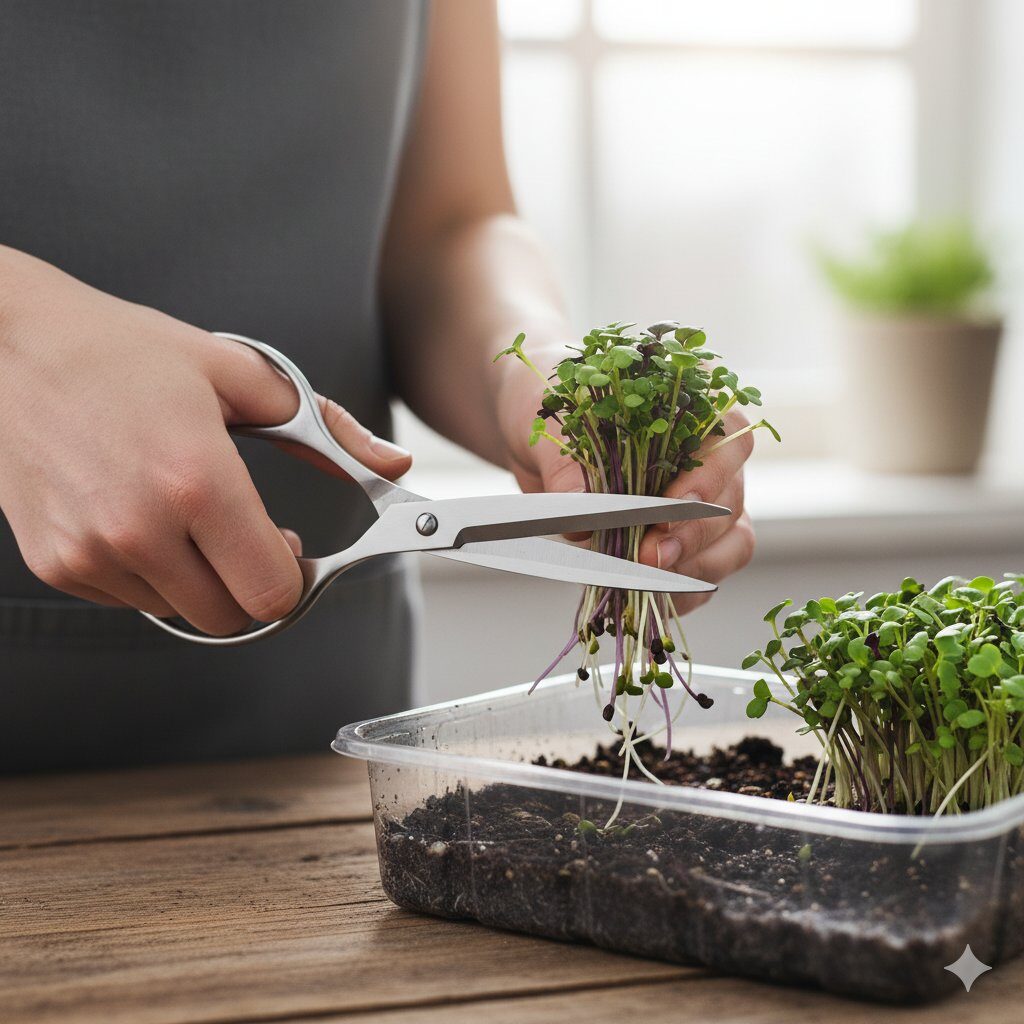
A live tray keeps growing on your windowsill. You cut what you need — a handful over your dal, a pinch on your eggs — and the rest keeps going. There's no cold chain to trust because there's nothing to refrigerate.
This isn't a marketing claim. It's biology. A living plant retains its phytochemicals until the moment you cut it. A cut plant begins losing them immediately. USDA research confirms that microgreens hold their nutrient density precisely because they are harvested before the dilution that occurs during maturation.2
When do cut packs actually make sense?
Cut packs make sense for restaurants and bulk buyers who need a consistent, measured portion for plating. They're also easier for people who want microgreens as a one-time add-on and have no interest in keeping a tray on the counter.
For home use, the portion control argument is weaker than it sounds. A single tray lasts most households 5–7 days of daily use.
| Factor | Live Tray | Cut Pack |
|---|---|---|
| Peak nutrition | ✓ Cut at the moment you eat | Depends on cold chain integrity |
| Shelf life in your kitchen | ✓ 7–14 days, growing | 2–7 days refrigerated |
| Waste | ✓ Use only what you need | Full pack opens at once |
| Convenience | Requires space on a counter | ✓ Open and eat |
| Ideal for | ✓ Daily home cooking | Restaurants, bulk orders, one-time use |
Does a live tray actually suit the Indian kitchen?
Indian cooking is not salad culture. We don't serve microgreens raw in a bowl and call it lunch. We add them to dal at the end, fold them into raita, scatter them over poha. Small quantities, used often. A live tray fits this pattern exactly. A 200g cut pack does not.
There's also the question of flavour. Methi microgreens cut fresh have a sharpness that fades noticeably within 48 hours of being cut. If you've tried microgreens and thought they were bland — you may have just tried them too late.
For daily home use in an Indian kitchen, a live tray is almost always the better choice. More nutrition, less waste, lower cost per use, and the flavour is incomparably better. Cut packs have their place — just not on your kitchen counter.
Harit delivers live trays — still growing — within 24 hours across Bhopal. Cut-to-order available for restaurants.
Order a Live Tray on WhatsApp →1 Singh A. et al. (2024). Emergence of microgreens as a valuable food, current understanding of their market and consumer perception. Food Chemistry: X, 23, 101527. Microgreens refrigerated at 1–4°C maintain freshness for up to 14 days; shelf life at room temperature is 2–3 days.
2 Concentration of bioactive compounds in plants decreases as they mature and post-harvest. The short growth cycle of microgreens prevents significant reduction in bioactive compound concentration — but this applies to live or freshly cut product only (Singh et al., 2024).